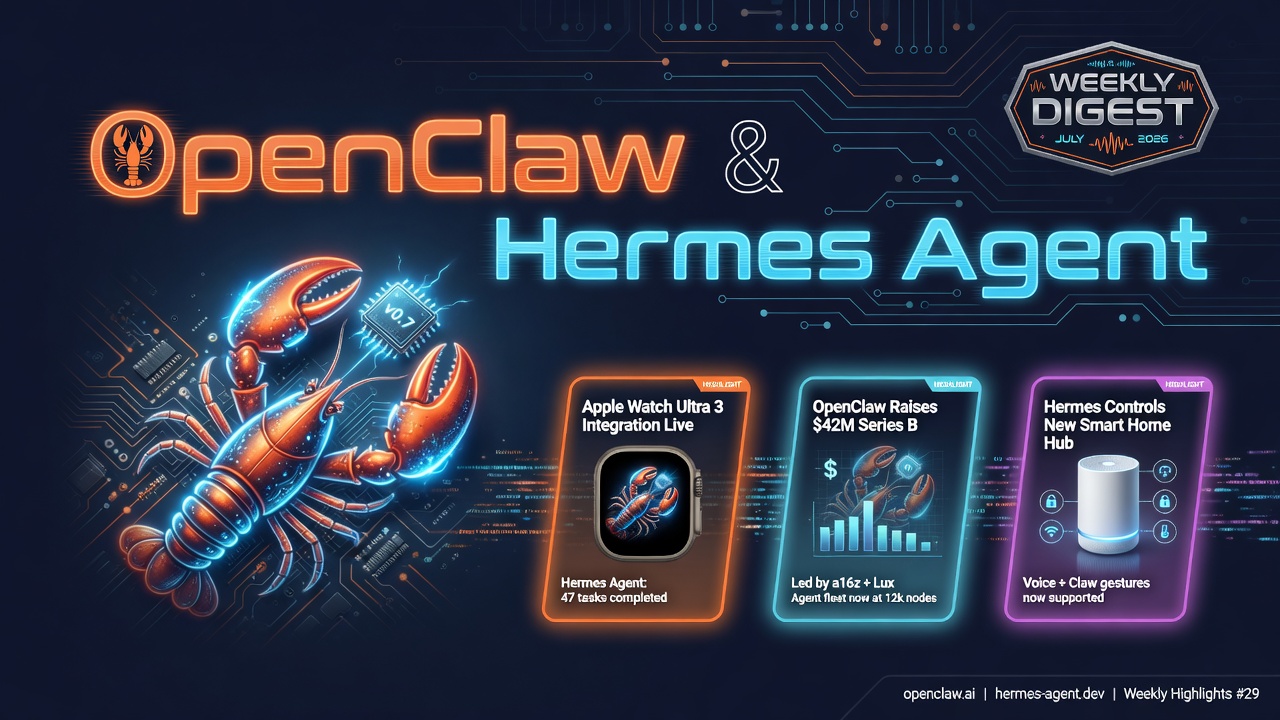
This week brought a major release, a billion-dollar funding signal, and a community hardware build that deserves its own tutorial series. Here are the three OpenClaw and Hermes Agent stories from X you need to see.
1. OpenClaw v2026.7.1 Drops with 535 Likes — Apple Watch Talks, Sessions Stack, GPT-5.6 Arrives
OpenClaw's official v2026.7.1 release landed July 13 and immediately caught fire on X — 535 likes on the announcement from @openclaw, and for good reason. This is not a maintenance release. The Control UI has been fully rearchitected around sessions as the primary object, complete with a searchable sidebar and resizable multi-session panes you can tile side-by-side or stack vertically, all preserved across reloads. The Apple Watch now gets full voice turns with spoken replies and on-wrist controls. Android ships pre-painted offline session and transcript caches so sessions load even when connectivity drops. On the onboarding side, the Crestodian agent-loop now guides new users through provider setup with masked credentials and exact-operation approvals — a meaningful reduction in friction that has been one of the community's most-requested improvements. Model support expanded significantly: GPT-5.6 is the default for fresh installs, Claude Sonnet 5 and Mythos 5 are in, Meta Muse Spark 1.1 ships with full Responses API support and streaming tool calls, and ClawRouter is now bundled natively with dynamic routing, per-provider quota tracking, and budget reporting. Messaging channels got heavy attention too — Telegram, Slack, Discord, and Apple Messages all received significant delivery, attachment, and progress improvements. The release credits 3,063 contributions from 532 contributors, making it one of the most community-shaped drops in OpenClaw's history.
https://x.com/openclaw/status/2076900503259414944
2. Nous Research Is Raising $75M at a $1.5B Valuation — the Hermes Agent Bet Gets Serious
The Hermes Agent ecosystem just received one of the clearest market signals yet: Nous Research — the team behind Hermes — is in advanced talks to raise at least $75 million led by Robot Ventures, at a reported $1.5 billion valuation. TechCrunch broke the story on July 13, and it immediately lit up X. Nous had previously raised roughly $70M total, including a $50M Series A led by Paradigm in April 2025. What makes this round remarkable is the context it lands in: Hermes already topped OpenRouter's daily token rankings in May 2026, clocking 271B tokens per day versus OpenClaw's 245B, and the self-improving "do, learn, improve" skill loop has been steadily converting OpenClaw power users who want a lighter, more autonomous runtime. A $1.5B valuation for an open-source agent framework is a market statement that agentic AI is infrastructure — the kind of number that brings enterprise engineering teams and serious operators into the ecosystem. X reaction split predictably: OpenClaw loyalists pointing to their 9.1 trillion cumulative token lead and arguing daily fluctuations don't tell the whole story, while Hermes advocates focused on usage trajectory and the compounding advantage of a self-improving agent that gets better simply by running. Either way, the agent wars now have institutional capital behind both sides.
3. A $59 Home Assistant Voice PE Becomes a Dedicated, Self-Improving OpenClaw Voice Assistant
Community builder tristanbrotherton published a build this week that has r/openclaw calling it one of the most complete hardware integrations the community has produced. The subject: the Home Assistant Voice PE, a small speaker puck that retails for about $59. The approach: replace the stock firmware entirely with a custom ESPHome build and a companion Home Assistant add-on backend that wires the device directly into OpenClaw. The result is genuinely impressive. Speech-to-speech runs via the OpenAI Realtime API with sub-second response times and full barge-in support — no half-second gaps, no robotic pauses. A custom wake word ("Hey Leonard" by default, trivially changed) triggers the agent. On-device speaker recognition does local voice enrollment for per-user access control, so family members get different permissions without any app-switching. Home Assistant smart-home control is deep: lights, locks, scenes, automations all accessible by voice through the same interface. The part that drew the most discussion is the self-improvement loop: every false wake-word trigger gets logged and fed into a weekly model retrain flywheel, with a notification delivered through OpenClaw when retraining completes. The assistant literally gets better at knowing when you're talking to it, automatically, with no manual tuning. Complex requests escalate seamlessly from the device up to full OpenClaw agents for tasks that need tools, memory, or multi-step reasoning. The full ESPHome firmware and HA add-on are open-sourced on GitHub, making this a drop-in recipe for any OpenClaw user with a Voice PE sitting on a shelf.
Spotted something great on X about OpenClaw or Hermes Agent? Share it — the community is the best part.