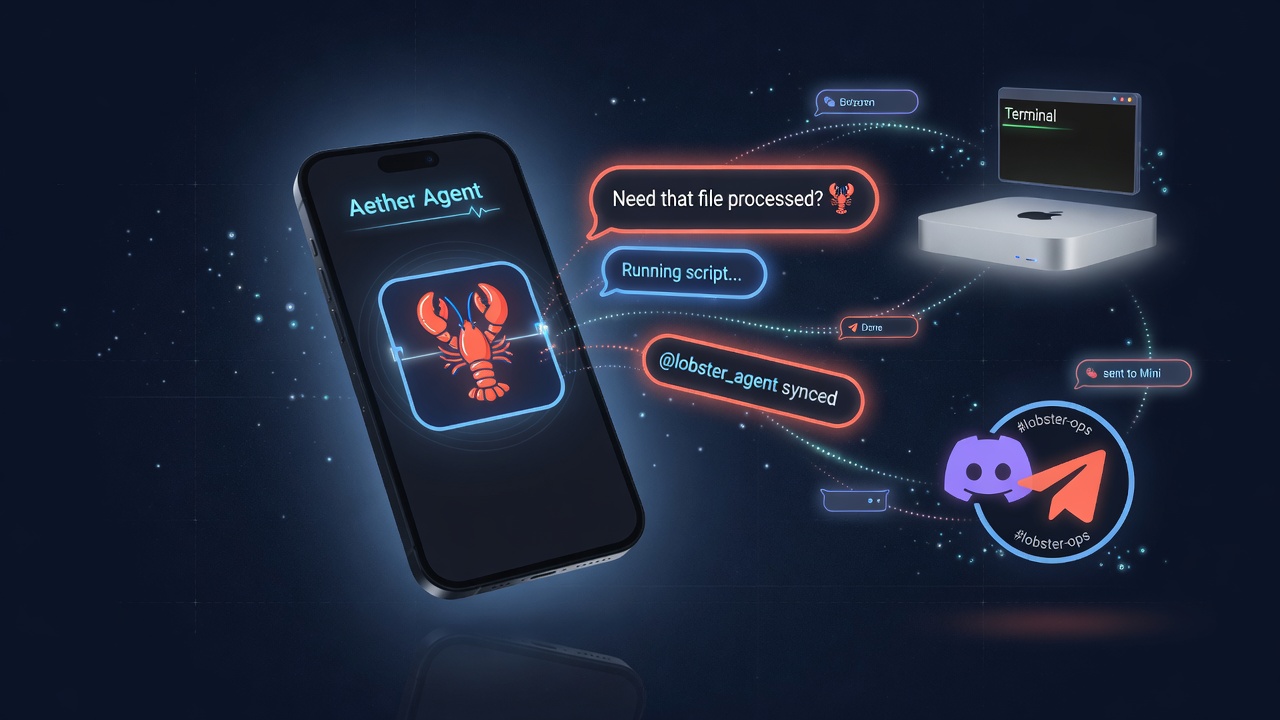
This week's highlights feature the biggest platform launch in OpenClaw's history, a stealth model reveal that dominated OpenRouter rankings for two months before anyone knew its name, and a real-world case study from a well-known AI engineer on running a 115k-star GitHub repository on autopilot. Here are the three stories worth your attention this week.
1. OpenClaw Is Finally on Your Phone — For Real This Time
After years of routing agent interactions through Telegram and WhatsApp bots, OpenClaw dropped official native iOS and Android apps on June 29. The iOS version landed on the App Store for free, supporting iPhone, iPad, and Apple Watch; the Android version hit Google Play the same day. These aren't standalone agents — they're secure mobile node apps that connect to your self-hosted gateway and add voice chat, action approvals, and device-native permissions (camera, location, photos) to the mix. The @openclaw announcement racked up thousands of likes and reposts almost immediately, with reactions ranging from "this changes everything" enthusiasm to early-adopter bug reports (the Android app opened to a 2.2-star average, and several users flagged rough onboarding and clunky initial setup). 9to5Mac, MacRumors, and Engadget all covered the launch within hours. The rough edges are real — a first-day App Store release for an open-source project always is — but what the apps establish is significant: an agent that can follow you off your desk, approved by Apple, available to anyone with a GitHub account and a gateway to run. The community has been anticipating this for over a year.
https://x.com/openclaw/status/2071688039114342592
2. The Stealth Model Running Your Agents Was Meituan's All Along
On June 29, 2026, Meituan's AI research lab officially unmasked "Owl Alpha" — an anonymous model that had been quietly running on OpenRouter for nearly two months — as their LongCat-2.0: a massive 1.6 trillion-parameter mixture-of-experts agentic coding model. The numbers were what stopped the community cold: #1 by monthly calls on Hermes Agent, #3 by monthly volume on OpenClaw, and #2 on Claude Code — all achieved as an anonymous model, no marketing, no benchmarks, just real agent workloads in the wild. By the time of the reveal, LongCat was processing approximately 11 trillion tokens per month on OpenRouter with 200–242% month-over-month growth. The detail that generated the loudest reaction: trained entirely on Chinese chips, not NVIDIA hardware. VentureBeat covered it immediately, framing it as the most significant model reveal of the year for the agentic AI community. Meituan simultaneously open-sourced the weights. For the OpenClaw and Hermes Agent communities, the significance is specific: this isn't a lab model adapted post-hoc for agents — it's a model that earned its rankings organically through real agent workloads before anyone knew what it was. The dominant community reaction was swift: "A Chinese food-delivery company just dropped the best agentic coding model of the year, stealth, on Chinese chips, and it's free."
https://x.com/Meituan_LongCat/status/2071624742701080606
3. @Saboo_Shubham_'s 24/7 Agent Squad Is Running a 115k-Star GitHub Repo
On June 28, Shubham Saboo (@Saboo_Shubham_) — Senior AI PM at Google and creator of Awesome LLM Apps, one of GitHub's most-starred repositories at 115k+ stars — posted a 19-minute breakdown of how he replaced the day-to-day curation work on that repo with a multi-agent team running continuously via OpenClaw and Hermes Agent, controlled entirely from Telegram. The squad design is the shareable part: automated cron schedules for proactive heartbeats, shared persistent memory for preferences, audience context, and prior decisions, self-improving review loops (a dedicated "Monica" reviewer agent grades the squad's output bi-weekly while individual agents review their own work monthly), and a clean human escalation path that routes final approval decisions to Saboo's phone without requiring him to re-prompt or context-switch. OpenClaw anchors the squad orchestration and handles broad workflow routing; Hermes provides the self-improving layer that compounds over time. The division is deliberate — OpenClaw for coordination, Hermes for growth. The thread drew strong engagement not just for the scale (a 115k-star open-source project maintained largely by agents) but for the clarity of the system design. What resonated most in replies was the explicit three-tier separation: autonomous execution, autonomous self-review, and human oversight. "The agents handle the heavy lifting. I handle the decisions." For builders running large open-source or content projects, this is a practical playbook, not a demo.
https://x.com/i/status/2071293463447097625
Spotted something great on X about OpenClaw or Hermes Agent? Share it — the community is the best part.