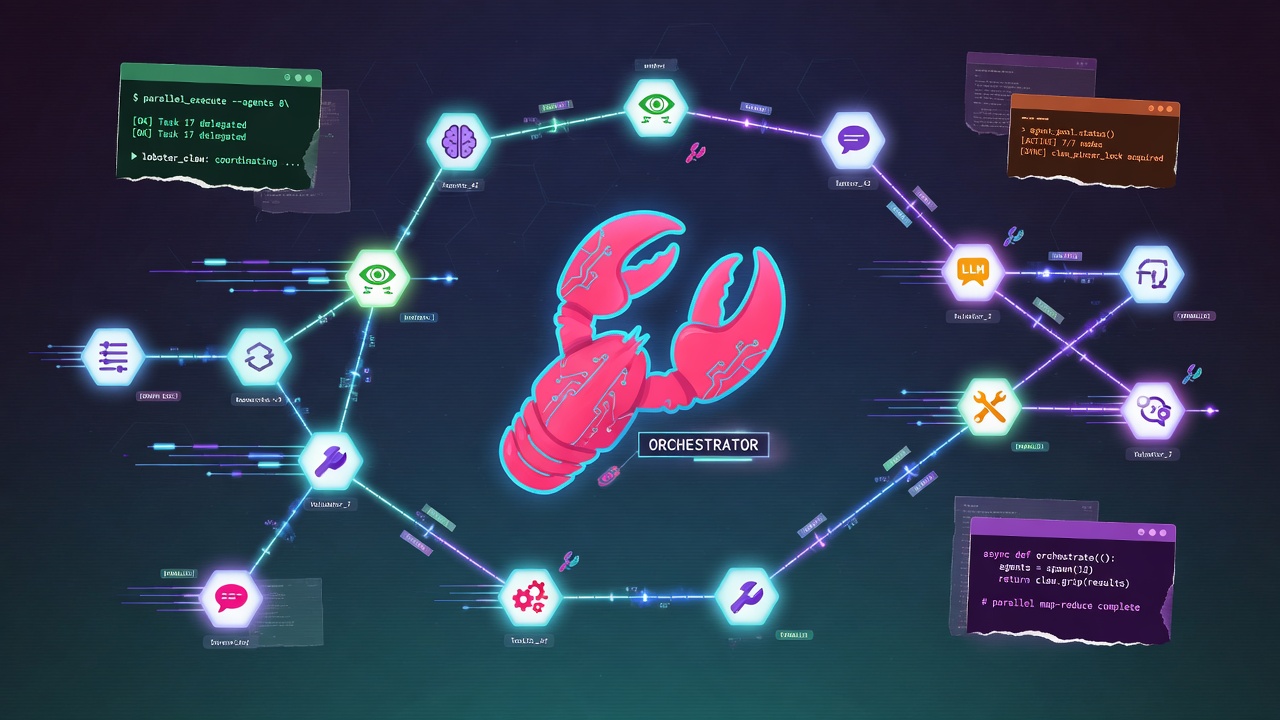
Every week the OpenClaw (@openclaw) and Hermes Agent (@NousResearch) communities surface ideas that are quietly changing how people build and work. Here are three this week that deserve a bookmark.
1. 🤖 Running 12 Subagents in Parallel to Hunt 200 Bugs — Peter Steinberger's OpenClaw QA Playbook
Peter Steinberger (@steipete), creator of OpenClaw (@openclaw) and now at OpenAI, shared the exact prompt he gave his Codex agent to run a full end-to-end QA test of OpenClaw ahead of a major release — and it reads like a blueprint for the future of automated software engineering. The prompt itself is the insight: spin up 12 subagents, each scoped to a distinct area of functionality; launch dev gateways on separate ports to avoid state contamination between environments; use worktrees so agents can work in parallel without branch collisions; have them create PRs autonomously for every fix; set the target at 200 bugs found and fixed; and mandate that every fix addresses the root cause — no band-aids — with refactors allowed everywhere except the plugin SDK boundary. The agents ran all day, with "Sol" (the orchestrating Codex agent) handling complex behavioral issues and continuously updating a live Markdown bug report to his desktop. The choices here are worth studying: separate gateway ports prevent cross-environment contamination, worktrees allow divergent branch states simultaneously, and the PR-per-fix discipline creates a complete auditable record of everything the agents changed. It's the most detailed end-to-end agentic QA blueprint currently circulating in the OpenClaw community — and it works.
https://x.com/steipete/status/2081169376317932017
2. 🏗️ OpenClaw + Buzz: A Two-Layer Stack for SOP-to-Delivery Pipelines
Brad Groux (@BradGroux), a former Microsoft maintainer for OpenClaw (@openclaw), shared a workflow structure this week that reframes how to think about agentic stacks: separate planning from execution entirely. His setup uses Buzz — a self-hosted, relay-based workspace platform — as the planning layer, where he and agents collaboratively draft SOPs and PRDs with full shared context and memory across tools. Once a spec is approved, execution is handed off to dedicated agents: GitHub Issues get cut, Codex or Claude Code handles implementation, and Veritas Kanban (Brad's own local-first task tracker) provides visibility across branches and lifecycle states. OpenClaw fills the operations channel role, coordinating across the stack. The separation is intentional: by the time any code is written, the planning work is done and documented — no agents guessing at intent. Brad noted a full video walkthrough and public repo are coming later this week, making this one worth following closely. It's a clean and replicable blueprint for anyone building multi-agent delivery pipelines with real governance.
https://x.com/BradGroux/status/2081529908061233552
3. 🔒 The Zero-Cost, Fully Local OpenClaw + Hermes Stack
Kevin Liu (@kevskgs) posted a clean blueprint for running OpenClaw (@openclaw) and Hermes Agent (@NousResearch) entirely on local hardware, at zero ongoing token cost. The stack: Ollama for running open-weight LLMs offline, AgentENV (from Moonshot AI) for scalable agent environment management with fast snapshot, resume, and fork capabilities, SmolVMs from @smolmachines for isolated sandboxes, and Hermes Agent + OpenClaw as the execution and orchestration layer on top. Everything stays on your machine — no cloud calls, no subscription, no API bills. The setup is especially timely as both Ollama and AgentENV have matured enough in 2026 that the performance gap with cloud APIs has narrowed significantly for many task types. For anyone running frequent agent workflows — research pipelines, overnight automation, daily skill-building loops — this is the most complete free-and-private blueprint currently being discussed in the community.
https://x.com/kevskgs/status/2082009533657067540
Spotted something great on X about OpenClaw or Hermes Agent? Share it — the community is the best part.