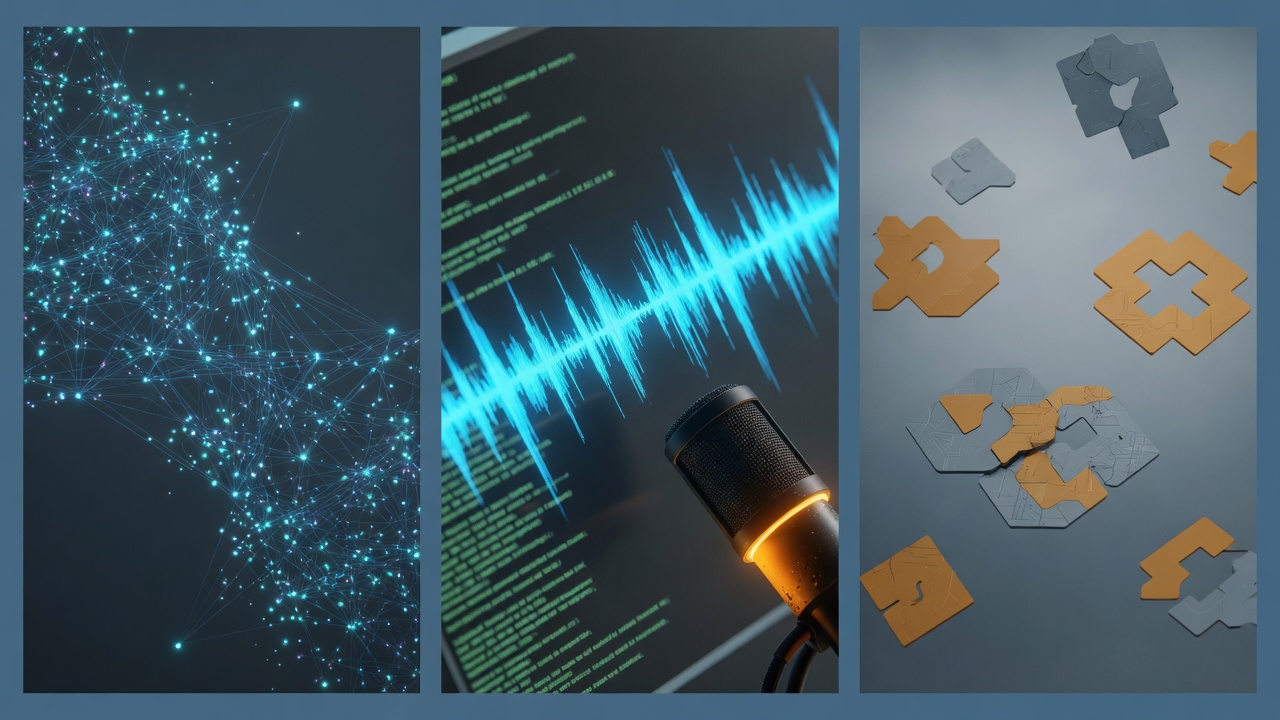
This week's top AI stories go purely technical: Moonshot AI drops the largest open-weight model in history at 2.8 trillion parameters, xAI launches a rebuilt voice model targeting production enterprise agents, and Anthropic's Claude Opus 5 scores 30.2% on ARC-AGI-3 — nearly four times higher than any previously recorded model.
1. Moonshot AI Releases Kimi K3 — The Largest Open-Weight Model Ever at 2.8 Trillion Parameters
On July 27, China's Moonshot AI published the full open weights for Kimi K3 on Hugging Face, setting a new record as the largest publicly downloadable AI model in history at 2.8 trillion parameters. The architecture is a Mixture-of-Experts design with 896 experts, activating approximately 104 billion parameters per token during inference. The model ships with a native 1,048,576-token (one million) context window and supports multimodal inputs including vision and video. Moonshot introduced Kimi Delta Attention — a hybrid linear-attention mechanism with Attention Residuals — that delivers up to 6.3x faster decoding in long-context workloads compared to standard attention. Weights are distributed in MXFP4 four-bit precision across 96 safetensors shards, totaling approximately 1.4 terabytes, alongside a 47-page technical report. Day-zero inference is available immediately from providers including Together AI and Modal. Early benchmarks show Kimi K3 outperforming Claude Fable 5 on the Frontend Code Arena leaderboard, and Moonshot's Mooncake disaggregated inference system — which separates prefill and decode stages across node pools — enables high cache hit rates on coding workloads.
2. xAI Launches Grok Voice Think Fast 2.0 — A Next-Gen Speech-to-Speech Model for Voice Agents
On July 29, xAI released Grok Voice Think Fast 2.0, a rebuilt speech-to-speech voice model targeting developers building AI-powered voice agents for production deployments. The model scores 82.9% on the Artificial Analysis Speech-to-Speech Quality Index — up from 75.7% in v1.0, ranking #2 overall — and earns the top spot on Tau Voice for agentic task performance at 56.5%. Time-to-first-audio is 0.70 seconds. Transcription accuracy improved 1.4x over version 1.0 and outperforms Deepgram Nova 3 and ElevenLabs Scribe v2 by 1.5–2x across 24 languages, with the greatest gains in noisy environments. The model supports real-time, full-duplex conversational workflows — allowing both sides of a conversation to speak and respond simultaneously without a turn-end delay. It is available immediately via the xAI API and Voice Agent Builder at $0.08/minute; the grok-voice-latest endpoint will auto-route to 2.0 on August 5. xAI also published A/B test results from Starlink deployments showing measurable gains in sales conversion and support containment rates, giving the benchmark numbers real-world validation.
https://x.ai/news/grok-voice-think-fast-2
3. Claude Opus 5 Posts 30.2% on ARC-AGI-3 — 3–4x Higher Than Any Previous Model
Anthropic's Claude Opus 5, released on July 24, has produced benchmark numbers that have shaken the AI research community. The headline result: 30.2% on ARC-AGI-3 at high reasoning effort — the most challenging abstract reasoning evaluation currently in use, specifically designed to test generalization over novel visual patterns that cannot be solved by memorization. The previous best model score was approximately 7–8%; Opus 5 nearly quadrupled it. The ARC Prize organization independently verified the result — a level of scrutiny that is rare in the industry and significantly more credible than self-reported claims. Additional benchmark scores include 97.5% on ARC-AGI-1, 88.3–90.4% on ARC-AGI-2, 43.3% on Frontier-Bench (tied for the frontier in agentic coding), 96.0% on SWE-bench Verified, and 70.57% on OSWorld 2.0 for computer-use tasks. Anthropic held pricing at the same level as prior Opus tiers. The ARC-AGI-3 result has reignited debate in the research community about whether frontier models are developing genuine abstract reasoning ability, or finding new statistical shortcuts that current benchmarks cannot yet distinguish from true generalization.