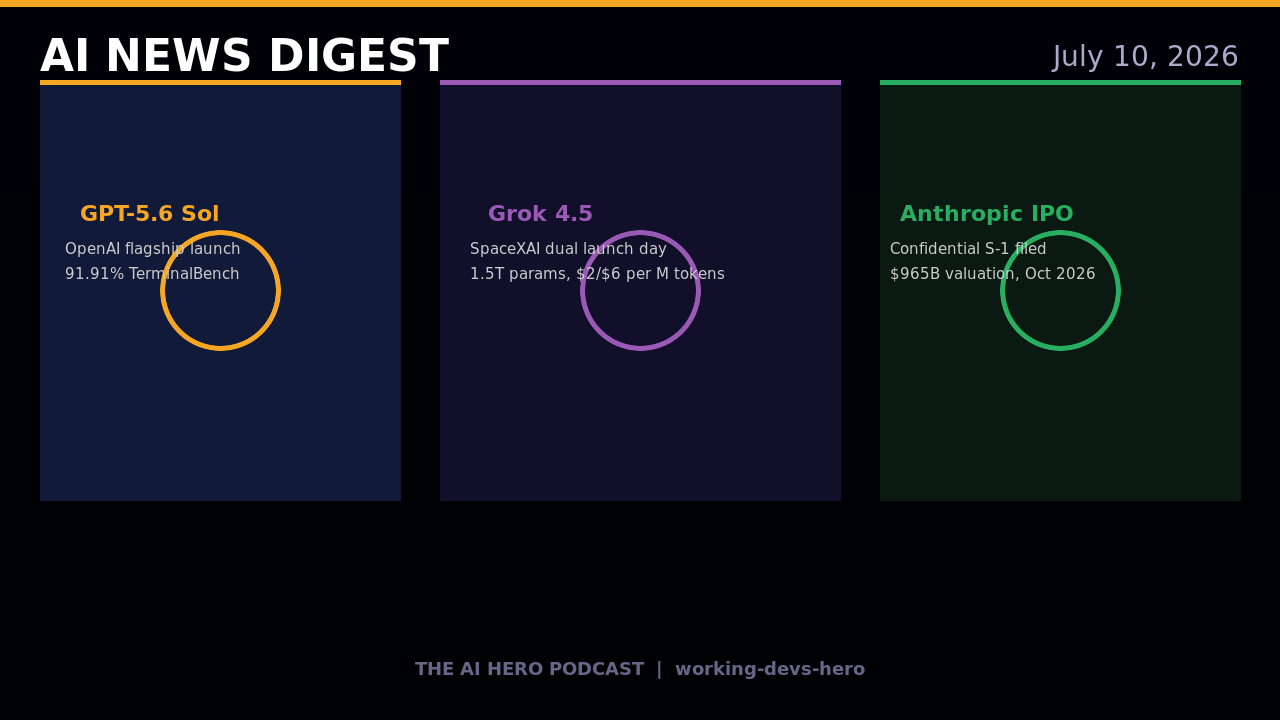
Three stories define the AI week of July 10, 2026: a historic dual model launch that's never happened before in AI history, and the most anticipated tech IPO in years preparing for takeoff.
1. OpenAI Releases GPT-5.6 Sol, Terra & Luna After 12-Day Government Preview
OpenAI publicly launched the GPT-5.6 model family this week — Sol, Terra, and Luna — following a 12-day government-gated preview period in which only about 20 vetted organizations had access. The delay was voluntarily agreed to at the request of the White House, which wanted the Office of the National Cyber Director and Office of Science and Technology Policy to stress-test Sol's advanced cybersecurity capabilities before a broad release. With the Department of Commerce now granting approval, all three tiers are live across ChatGPT, the OpenAI API, and Codex. Sol is the flagship model — targeting hard reasoning, complex coding, and long agentic workflows — scoring a record 91.91% on TerminalBench 2.1, ahead of both GPT-5.5 (83.4%) and Anthropic's Mythos 5 (88%). Terra offers GPT-5.5-level performance at approximately half the cost ($2.50/$15 per million tokens), while Luna is the fastest and most affordable option in the family ($1/$6 per million tokens). OpenAI is also launching Sol on Cerebras hardware, delivering up to 750 tokens per second for customers requiring frontier-level speed at scale.
https://openai.com/index/previewing-gpt-5-6-sol/
2. SpaceXAI Launches Grok 4.5 — The First-Ever Simultaneous Dual Frontier Model Launch
In an unprecedented moment for the AI industry, SpaceXAI (formerly xAI, rebranded after SpaceX's acquisition) released Grok 4.5 on the same day as OpenAI's GPT-5.6 — the first time two competing frontier-class models have gone public simultaneously. Built on the V9 architecture with approximately 1.5 trillion parameters, Grok 4.5 is also the first model jointly trained with Cursor IDE data, following SpaceX's $60 billion acquisition of Anysphere in June 2026. Elon Musk describes it as an "Opus-class model, but faster, more token-efficient and lower cost" — priced at just $2 per million input tokens and $6 per million output tokens, dramatically undercutting Anthropic's Claude Opus 4.8 at $5/$25 per million tokens. Benchmark results are impressive: Grok 4.5 leads the SWE Marathon leaderboard with a pass@1 score of 29%, ahead of Opus 4.8 at 26%, and scores 83.3% on TerminalBench 2.1. The model is available now through Grok Build, Cursor on all subscription plans, and the SpaceXAI developer console. European availability is expected around mid-July.
3. Anthropic Files Confidential IPO S-1, Targets October Nasdaq Listing at $965 Billion Valuation
Anthropic is heading to Wall Street. The company filed a confidential S-1 registration statement with the SEC on June 1, 2026, targeting a Nasdaq debut in October with Goldman Sachs, JPMorgan, and Morgan Stanley leading the offering expected to raise more than $60 billion. The post-money valuation stands at $965 billion following a $65 billion Series H funding round — meaning Anthropic could become the first company in history to debut on public markets at or near a one-trillion-dollar valuation. Revenue has grown explosively: the company reached a $47 billion annualized run rate as of May 2026, up from just $10 billion a year prior. Claude Code alone now contributes over $2.5 billion in annualized run-rate revenue. The company currently spends approximately $19 billion annually on compute, with gross margins at roughly 40% today and a target of 77% by 2028. Profitability is projected for 2028, and analysts are watching whether the growth trajectory can justify the valuation at IPO.
https://www.cnbc.com/2026/06/01/anthropic-ipo-s1-prospectus.html