Google AI Overviews now reach more than 2.5 billion users a month and appear on almost half of all searches. ChatGPT carries more than 900 million weekly active users. Against that, one number does the real damage: only 16% of brands systematically track whether they appear inside those answers at all.
That figure — drawn from McKinsey CMO survey data — sits near the front of a 36-page framework the Interactive Advertising Bureau released on August 3, 2026, titled Measuring Visibility in the AI Era. It is the first industry-wide attempt to standardize how brands and publishers measure organic presence inside AI-powered discovery: ChatGPT, Google AI Overviews and Gemini, Microsoft Copilot, Perplexity, Claude. Not how to win those surfaces. How to know whether you're on them.
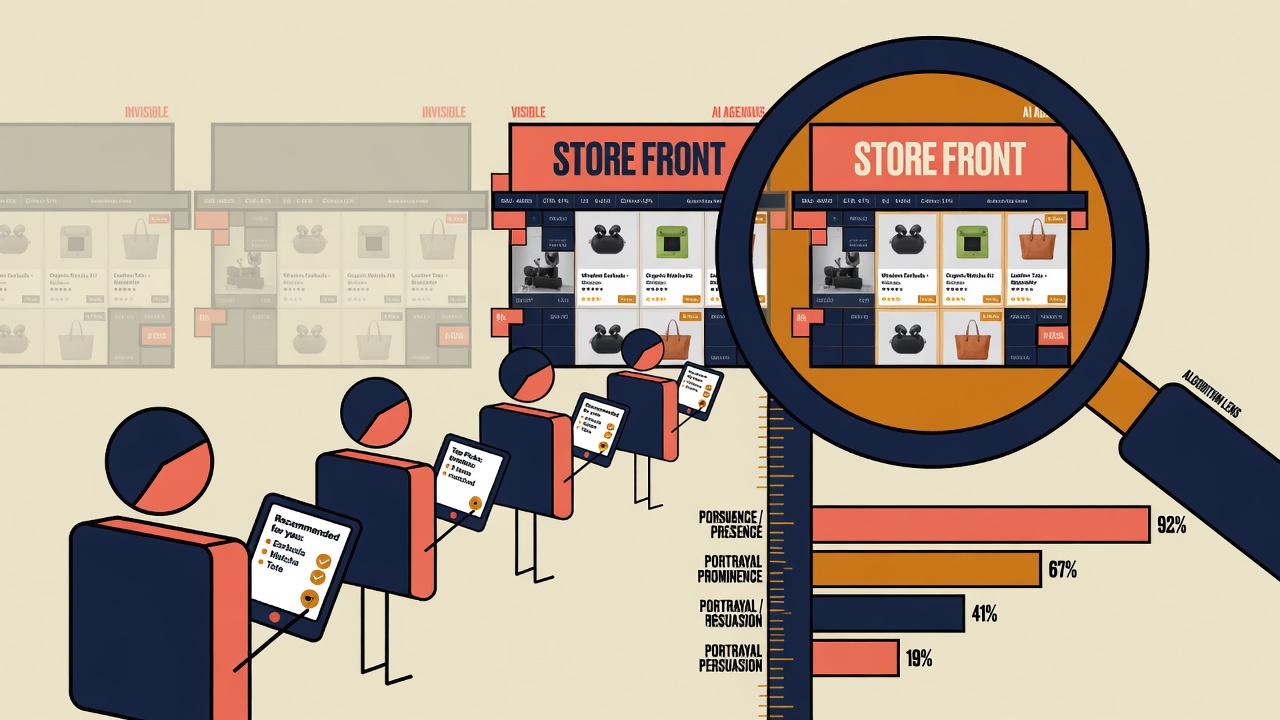
For anyone building in agentic commerce, this is not a marketing housekeeping item. When an agent evaluates products, narrows a set, checks live inventory and completes a checkout, the model's answer is the shelf. Recommendation language becomes endcap placement. Citation becomes distribution. And right now most brands are allocating budget against that shelf with no instrument capable of reading it.
The gap the IAB is actually addressing
More than 20 companies now sell AI visibility tools. Each uses a different methodology, and each produces different answers for the same brand or publisher. That is the core problem — not scarcity of measurement, but an abundance of incompatible measurement.
The IAB's framing is blunt: optimization without measurement is guesswork. A brand cannot know whether its GEO investment is working, or whether a competitor is gaining ground, or whether a platform update helped or hurt, unless there is a common standard for measuring any of it. Vendors are selling confidence; the underlying numbers don't reconcile.
The pressure behind this is not theoretical. McKinsey projects that brands unprepared for AI-mediated discovery could see traffic declines of 20% to 50% from traditional search channels. Publisher data is already there. Chartbeat figures reported by Axios in March 2026 and cited by the IAB show search referral traffic down 60% for small publishers, 47% for medium, and 22% for large over the past two years. AI chatbot referrals grew more than 200% from December 2024 to December 2025 — and still account for less than 1% of total publisher page views. The old channel is contracting faster than the new one replaces it.
Commerce is earlier in the curve but moving. AI Overviews currently appear on 14% of shopping queries. That number is the one to watch, because it is the leading indicator for whether discovery-stage product research relocates into generated answers wholesale.
And the SEO dashboard on your wall does not cover it. Research from LQ found that over 40% of brand citations appearing in organic search results do not appear in AI overviews for the same query. Two different realities, one of which almost nobody is instrumented for.
The 4 P's: presence, prominence, portrayal, persuasion
The framework's spine is a causal hierarchy the IAB calls the 4 P's of AI Visibility. The sequencing matters — each layer is meaningless without the one below it.
Presence asks whether you exist in the response at all. For brands: Mention Rate, Citation Rate, Share of Voice, and Visibility Momentum. For publishers: Citation Rate plus Citation Decay Rate, which tracks how quickly a model stops relying on your content.
The gap between Mention Rate and Citation Rate is itself diagnostic, and it's the nuance most vendor dashboards flatten. Being spoken about is not the same as being relied upon as a source. A brand with high mentions and low citations is present in the model's general knowledge but absent from its evidence layer — a fragile position that erodes when models retrain or tighten sourcing.
Prominence measures placement. For brands, Position within the response. For publishers, Content Utilization Rate — how much of the answer your material actually built.
Portrayal covers how you're characterized: Sentiment, Framing, Hallucination Rate, Factual Inaccuracy Rate. Publishers add Attribution Clarity. The distinction between the last two metrics is operationally sharp and deserves attention from anyone running brand risk. Hallucination Rate captures the model fabricating an association that does not exist. Factual Inaccuracy Rate captures the model correctly reflecting a wrong underlying source. Same symptom, completely different remedy — one is a model behavior problem, the other is a data-hygiene problem in the corpus you can sometimes go fix.
Persuasion is where commerce operators should focus hardest. For brands: Recommendation Strength and Post-Citation CTR. Recommendation Strength distinguishes active endorsement — "the best option because Y" — from generic inclusion in a list of six. In an agentic checkout flow, that difference is conversion. An agent asked to buy the best mid-range espresso machine does not enumerate; it selects.
Post-Citation CTR is the deliberate bridge to a forthcoming IAB attribution framework. It's the seam where visibility measurement will eventually meet commerce outcomes.
One disclosure requirement runs through the whole set: Share of Voice is only interpretable if the provider discloses how it defined the competitive category. Redraw the category and the number moves without anything real changing.
Directional versus decision-grade — the divide that matters
The most useful section of the framework has nothing to do with metric names. It's the quality tiering.
Exploratory programs run fewer than 50 queries. Directional measurement is adequate for early signal detection, internal briefings and competitive awareness — and explicitly not sufficient for budget allocation or executive strategy. Decision-grade measurement requires rigor across nine criteria: query volume and sample size; prompt type coverage spanning informational, comparison, recommendation and transactional intents; testing cadence of weekly or more frequent; reproducibility and stability under non-deterministic outputs; platform coverage with per-platform reporting; disclosure of variation ranges; documented validation methods; data architecture — active query simulation versus passive panel versus platform-native; and historical versioning when models change.
The IAB's assessment is that most of the 20-plus tools on the market are directional at best.
Read that against how these tools are being bought. Directional data is currently being presented in board decks and used to move media budgets. That is the actual exposure — not the absence of measurement, but the misclassification of it.
Providers are asked to disclose platform coverage and model versions, prompt library construction and query sourcing, data collection architecture, attribution and sentiment logic, factual accuracy classification, and historical baseline management. The framework's sharpest line for buyers: absence of disclosure should be treated as a signal.
Underneath all of it sits non-determinism. Identical queries return different responses. Platform updates can shift your metrics overnight with no change in your performance whatsoever. Any vendor reporting a clean single number without a variation range is hiding the physics.
Who built it
The working group is the tell. It was led by Caroline Giegerich, VP, AI at the IAB, and includes Breeze Zhao, Sr. Director of Measurement Science at Walmart; Ihab Rizk and Paul Longo from Microsoft Clarity; Haozhe Xu of WPP Media; Graham Wilkinson of Acxiom; Daniel Flynn of eMarketer; Jason Hartley of PMG; Simon Poulton of Tinuiti; Justin Inman of emberos; Todd Paris of IQRush.ai; Skye Yang; and Kristina Meinig and Scott Cunningham of the Alliance for Audited Media.
A retailer, a platform, a holding company, an identity firm, performance agencies and an audit body in the same room. The AAM presence is worth noting — that's the organization that has historically certified circulation and digital delivery. Its participation points toward the certification path the IAB has floated for the future.
Giegerich told AdExchanger that this is not a formal standard, because AI-search measurement is not stable enough yet. That candor is the framework's credibility. It does not rate providers, prescribe tools or build systems. It supplies shared vocabulary, quality criteria and disclosure requirements — a ruler, not a verdict.
The scope is narrow on purpose: organic, non-paid AI visibility only. No AEO/GEO tactics, no paid placement, no commerce attribution. Paid measurement is named an "adjacent priority" because organic and paid visibility increasingly appear on the same response surface — a sentence that should worry anyone who assumes those two things will stay separable.
The same-week signal from the merchant side
Days after the IAB release, an IDC InfoBrief sponsored by WooCommerce — Build for What's Next: Open-Source Architecture and the Future of AI Commerce — landed on the supply side of the same problem. Its finding: AI agents already function as a "second buyer," in Heather Hershey's framing at IDC, evaluating structured data, machine-readable metadata and live inventory rather than visual design. Most merchants are unprepared, many locked into closed systems with gated AI features.
IDC projects AI could replatform $500 billion in digital spending by 2030, with agent adoption among the Global 2000 growing 10x by 2027. Coverage of the study put the downside plainly: unprepared brands could lose access to 25% of their market.
Put the two documents together and the shape of the gap is clear. The IAB describes whether the agent can see you. IDC describes whether the agent can transact with you. Failing either one produces the same outcome.
What's still missing
Commerce attribution is the hole. Post-Citation CTR gestures at it; the forthcoming attribution framework is supposed to close it. Until then, a brand can measure that it was recommended and cannot measure what that recommendation was worth. Paid is out of scope on a surface where paid and organic are converging. Non-determinism means baselines will keep moving. And there is no certification yet — only the possibility of one.
None of that is a reason to wait. It's a reason to build your own instrumentation with the vocabulary now available, so that when certification arrives you're comparing against a history rather than starting one.
What to do before Q4 locks
The measurement gap is the whole thesis. Optimization without measurement is guesswork, and agentic commerce without visibility standards is flying blind at the discovery layer — while a fifth to a half of your traditional search traffic is potentially in play.
Audit your current vendor against the nine decision-grade criteria and demand the six disclosures in writing; if they won't state model versions and variation ranges, you have directional data being priced as decision-grade. Reclassify every AI visibility number already in your planning decks as exploratory, directional or decision-grade, and pull the directional ones out of budget-allocation conversations this quarter. Separate your Hallucination Rate from your Factual Inaccuracy Rate now, because the second one has a fixable root cause in third-party sources you can actually contact. Instrument Recommendation Strength on your top 20 transactional prompts — not mention counts, the actual endorsement language — since that is what an agent acts on. Run the LQ test on your own catalog by comparing organic citations to AI overview citations for your highest-value queries; if the divergence approaches 40%, your SEO dashboard is describing a market you no longer fully compete in. And close the second-buyer gap in parallel: structured data, machine-readable metadata, live inventory feeds, no gated AI features.
Holiday 2026 query volume starts building in October, and Q4 media commitments are being finalized now. A baseline established in August has three months of history behind it by peak season. One established in November has none.
Pull the framework, score your vendor this week, and put a number on what your shelf position actually is.
Sources
- IAB — Measuring Visibility in the AI Era (guidelines page)
- IAB — Measuring Visibility in the AI Era, full PDF (August 2026)
- PR Newswire — IAB Releases "Measuring Visibility in the AI Era"
- PPC Land — Only 16% of brands track AI visibility as IAB sets measurement standard
- Marketing Dive — IAB shares playbook for measuring brand visibility in AI-powered platforms
- AdExchanger — IAB's new advice on how to measure AI search visibility
- Authority Tech — IAB AI visibility measurement fragmentation and standards, 2026
- Ivris Tech — IAB AI visibility measurement framework
- WooCommerce — IDC study: Build for What's Next
- PR Newswire — AI agents are already shopping and most merchants aren't ready
- Enterprise Times — AI agents are already shopping, but most merchants are not yet ready