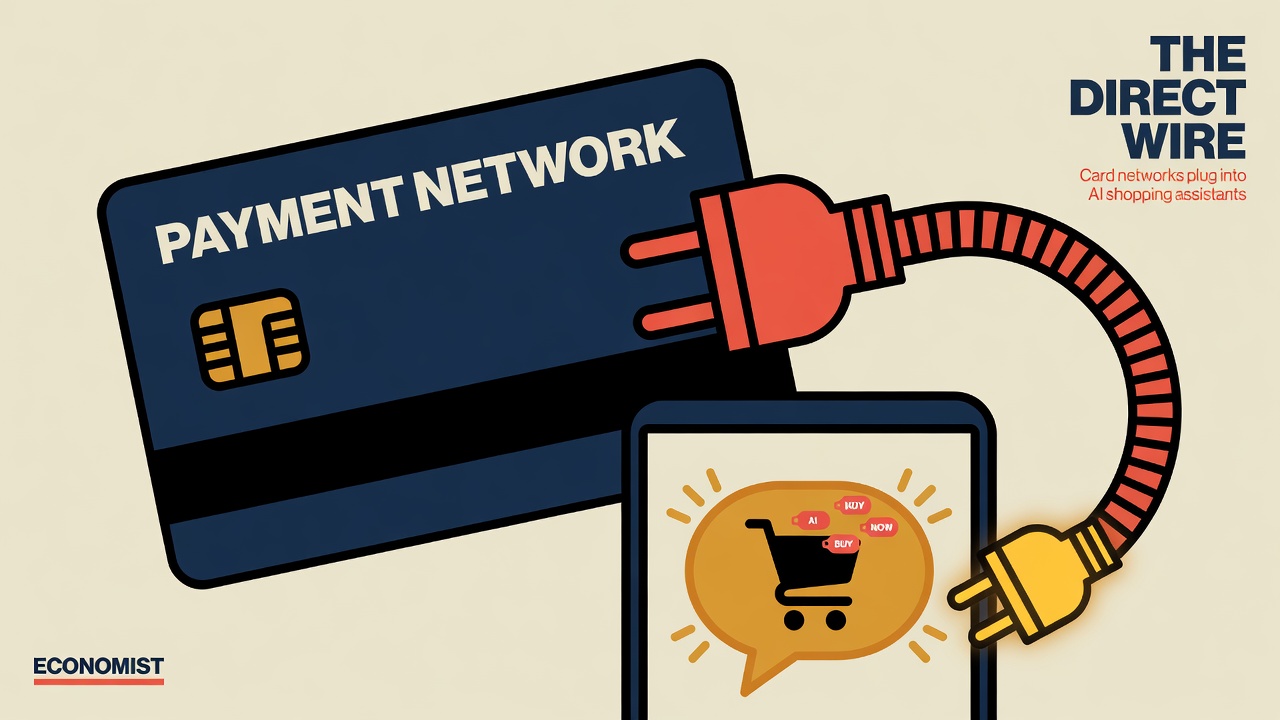
Roughly 75% of surveyed consumers say they distrust AI agents making autonomous payment decisions with their money and data. That number came from Visa CEO Ryan McInerney on September 8 at the Goldman Sachs Communacopia + Technology Conference. Twenty-four hours later, Mastercard launched a product designed to make exactly those payments frictionless at scale.
That gap — between infrastructure that now exists in specific, named, shippable form and consumer trust that measurably does not — is the story of this week in agentic commerce.
What Anthropic actually shipped, and what it left out
On September 2, Anthropic released Claude Commerce Agents, an Apache 2.0-licensed open-source blueprint at github.com/anthropics/commerce-agents. In Anthropic's own framing, it gives engineering teams "the harnesses, patterns, and guardrails" to launch a commerce agent quickly.
There are two agent types. The customer-facing shopping agent handles catalog search, multi-item planning, personalization, in-chat product comparisons, cart building, and post-purchase work like order status and returns. The staff-facing merchant agent does sales analytics, inventory monitoring, pricing and promotion recommendations, and marketing campaign drafts.
The guardrails are worth reading closely, because they reveal Anthropic's risk posture. Every merchant-agent write action requires human approval before it goes live — no autonomous changes to a running store. Prices and products must tie to actual catalog data rather than model output. The system is explicitly built to avoid manipulative upsell patterns. Engineering practices include tool iteration limits and prompt caching. Four vertical reference implementations ship with it: retail, travel, telecom, and ticketing/entertainment. Teams can deploy via the Claude API, Amazon Bedrock, Microsoft Foundry, or Google Cloud Vertex AI, using the Messages API, Agent SDK, or Claude Managed Agents (beta).
Here's the part that mattered most to the card networks. The blueprint deliberately excludes three things: a payment protocol, a product catalog, and an advertising layer. Anthropic built the reasoning layer for shopping and left checkout entirely to merchants' existing systems and payment partners. PYMNTS characterized it as building the shopping brain and skipping the wallet.
That omission was not an oversight. It was an opening.
Mastercard filled it in a week
On September 9, Mastercard launched Agent Connect — "a single integration point for merchants, AI agents, digital platforms and payment providers to connect and transact."
The pitch is protocol-agnostic plumbing. Rather than a merchant building a separate integration for every AI shopping platform that emerges, Agent Connect offers one connection across a growing ecosystem. It supports product discovery, cart assembly, and consumer-authorized transactions using merchants' live catalog data — real pricing, real descriptions, real stock levels. Merchants retain control over pricing, fulfillment, branding, and the customer relationship.
It runs alongside Agent Pay, Mastercard's agent payment technology launched in April 2025 and now backed by 30-plus partners including Stripe, Ripple, Coinbase, Adyen, Cloudflare, OKX, Solana Foundation, Checkout.com, and Global Payments. A feature called Verifiable Intent uses tokenized permissions to confirm that an agent's purchase was actually authorized by the customer — not merely inferred from some vague earlier instruction. That is the technical answer to the trust problem, and it is more substantive than a marketing checkbox.
The initial network launches in the United States with Bemobi, Getnet, Glance, Global Payments, Planet, Network International, Nexi, Samsung, Trip.com, Vodafone Egypt, Wizard, and Wompi. Mastercard's broader Agent Suite for Merchants added exploratory partners including Castlery, Fabrick, Fiserv, FreedomPay, Moneris, Worldline, and several of the above.
Most telling: Mastercard said explicitly that it is giving merchants a "commerce agent blueprint" pairing Claude models with its own payment infrastructure — building directly on top of the Anthropic release from seven days earlier — while continuing to collaborate with both Anthropic and OpenAI. Mastercard Chief Product Officer Jorn Lambert put the thesis plainly: "AI agents will change the buying interface again."
Visa was already in the frame. In Anthropic's own September 2 announcement, Visa's Jack Forestell said the collaboration blends Claude's intelligence with "the trust, security, and global reach of the Visa network." Mastercard's Sherri Haymond said the partnership helps "connect consumers, merchants and AI agents securely." Accenture's Kath Gramling framed it as helping clients "move from concept to production" faster. Intuit, Klaviyo, Wix, Zomato, Fetch, and Square also appeared in that announcement.
Who's actually running it
Shopify is building a reference storefront implementation, connecting merchants through Catalog, UCP, and Shop Sign-in. Priceline rebuilt its assistant Penny on Claude for multi-part trip planning — a genuinely hard use case, since travel involves sequencing flights, hotels, and cars under shifting inventory.
Anthropic also published performance numbers: retailers using the shopping agent saw carts "up to 35% larger," with shoppers "60% more likely to complete a purchase." Treat those carefully. They are self-reported, drawn from a single retail partner, and not independently verified. They are directionally interesting and evidentially thin.
The trust numbers cut both ways
McInerney's remarks deserve more attention than the headline distrust figure alone. His core observation: "We are seeing adoption for shopping, but not yet for autonomous payments." Consumers happily use AI to research and compare products, then go complete the purchase on the merchant's own website. The agent is a research tool, not a buyer.
"The barrier to that, if I had to describe it in one word, would be trust," he said.
But the underlying survey data contains a case for the networks. That 75% distrust figure drops to 61% when Visa is specifically named as involved in the transaction. And among consumers who use LLMs weekly, trust in Visa-backed agentic payments exceeds 70%. Brand trust transfers. Familiarity with the technology transfers more. The networks are betting that both curves move in their favor as agent usage becomes ordinary.
Merchants have their own reservations. PYMNTS Intelligence found roughly half of surveyed merchants are reluctant to cede control over pricing and the final price a consumer pays to AI agents. Separate PYMNTS Intelligence/Worldpay research found 43% of retailers are piloting autonomous AI shopping tools, while 95% of consumers report at least one concern about agentic commerce — payment security chief among them.
So: a meaningful minority of retailers are experimenting, nearly all consumers are worried, and the wallet layer just got built anyway.
McInerney also connected this to fraud strategy, describing a shift toward stopping identity fraud before it happens — relevant context for Visa's pending BioCatch acquisition — and called cybersecurity a "top 3 issue" raised by financial-institution clients worldwide. If agents transact on your behalf, identity verification stops being a login problem and becomes the entire security model.
The legal backdrop is settling
One adjacent development worth noting: the Ninth Circuit denied Amazon's petition for an en banc rehearing in Amazon v. Perplexity AI. No judge on the court even requested a vote. That closes the appellate chapter opened by the August 4 panel ruling, which vacated the injunction against Perplexity's Comet AI shopping agent; Amazon had filed its rehearing petition on August 18. The underlying case continues in district court on the merits. The immediate effect is that third-party agents shopping on platforms that would rather they didn't now operate without an injunction hanging over them.
The legal question is resolving. The trust question is not.
What to watch
Two concrete markers over the next quarter. First, whether Agent Connect transaction volume appears in Mastercard's next earnings disclosures in any specific, quantified form — or whether it stays in the qualitative "strong early partner interest" bucket, which would tell you the rails are live but empty. Second, and more decisive: the holiday 2026 shopping season. That's the first high-volume, high-stakes window in which consumers can either let an agent complete a purchase or, as McInerney describes them doing today, open a browser tab and pay the merchant themselves.
Watch the completion step, not the conversation — that's where the 75% either moves or doesn't.
Sources:
- Anthropic — Building Commerce Agents with Claude
- GitHub — anthropics/commerce-agents
- PYMNTS — Anthropic Debuts Commerce Agent Blueprint With Visa and Mastercard
- PYMNTS — Visa CEO Says AI Shopping Has Arrived but Agentic Payments Haven't
- Mastercard — How AI agents will transform shopping, payments and commerce
- crypto.news — Mastercard launches Agent Connect for AI shopping
- Hokanews — Mastercard Launches Agent Connect to Expand AI-Powered Shopping
- Courthouse News — No 9th Circuit rehearing in Amazon-Perplexity case